Galena and fluorite rarely float under the same conditions. Galena (PbS) is a sulphide and responds to sulphydryl collectors such as xanthates. Fluorite (CaF₂) is a salt-type mineral floated with fatty-acid collectors under close depressant control, and its separation problem is usually calcite and barite, which behave similarly enough in the cell that the split depends on staged cleaning. Two reagent regimes means two circuits: lead comes out first, and fluorite is floated afterwards from the lead tailing.
Xinhai's 1,200 t/d plant on Sardinia, Italy, runs that sequence. It was the company's 101st export destination and its first full EPC delivery in Europe, with scope running from mineral processing test work through design, equipment supply and installation supervision under a single EPC contract.
Why Galena-Fluorite Ores Are Awkward
The valuable minerals want different chemistry. You cannot run one rougher bank and clean up later. Lead is floated first with a sulphydryl scheme, and the fluorite circuit is then built on fatty-acid collectors with carbonate and sulphate depressants. Get the order wrong and lead reports to the fluorite concentrate, while the fluorite reagent scheme has to work in water that already carries xanthate.
Lead contaminates the fluorite product. Fluorite concentrate is sold against a specification, and that specification sets impurity limits. Lead carried into a fluorite concentrate can breach them. Pulling galena early protects the fluorite product as much as it recovers lead value.
The mass balance is lopsided. On this ore the head grade runs 30–32% CaF₂ against 1–3% PbS. The plant recovers a small mass of lead out of a much larger fluorite stream. The lead circuit can stay compact while the fluorite circuit carries the tonnage, and most of the cleaning capacity sits on the fluorite side along with most of the recovery loss.

Project Details
Ore and Site
Item | Parameter |
Location | Sardinia, Italy |
Ore type | Galena-fluorite (PbS + CaF₂) |
Head grade | CaF₂ 30–32%; PbS 1–3% |
Plant capacity | 1,200 t/d |
Grinding & flotation capacity | 900 t/d |
Crushed product size | 0–8 mm |
Grinding fineness | 60% −200 mesh |
Regrind fineness | 93.5% −200 mesh |

The 300 t/d difference between those first two rows is worth pausing on. Roughly a quarter of the plant feed never reaches the mill.
The Flowsheet, and Why It Is Ordered This Way
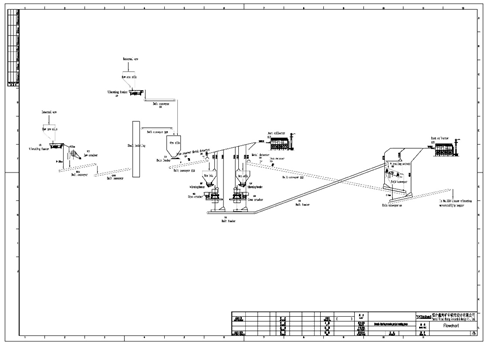
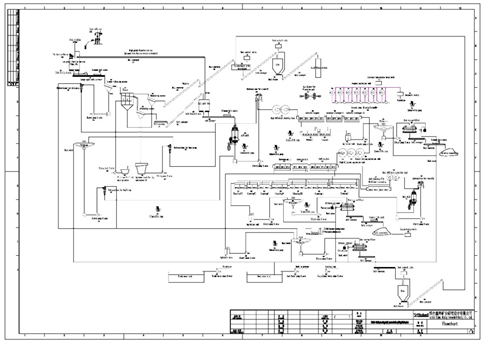
Crushing & screening → gravity pre-concentration → desliming → grinding & classification → galena flotation → fluorite flotation → concentrate dewatering → tailings dry stacking & backfill
- Gravity pre-concentration carries the load reduction. Coarse fluorite is recovered by jig ahead of milling, and jig tailings are dewatered and routed to crushing or grinding and then to the backfill station. This holds grinding and flotation at 900 t/d while the plant takes 1,200 t/d, so coarse waste leaves the circuit before it consumes grinding power.
- Desliming protects the fluorite circuit. Slimes coat bubble surfaces and consume fatty-acid collector, so the −2 mm fraction is deslimed before it joins the mill feed.
- Grinding is set by liberation. The circuit runs to 60% −200 mesh, with middlings reground to 93.5% −200 mesh. The primary grind follows how finely fluorite is intergrown with calcite and quartz. Under-grinding leaves composite particles that extra cleaning stages cannot separate.
- Galena flotation leads. One roughing, two scavenging and two cleaning stages pull lead out ahead of the fluorite circuit, producing a 63.58% PbS concentrate. Removing lead early lets the fluorite circuit run its own reagent scheme in cleaner water.
- Fluorite flotation is where the stages add up. One roughing, one scavenging and seven cleaning stages, with cleaner I–IV middlings reground and the scavenger recirculated. Those seven cleaners are what acid grade costs.
- Water stays in the plant. Process water from both circuits is recycled. Tailings are thickened and filtered, and the dry cake goes to backfill instead of a pond.
Control and Execution
Metallurgy only holds if the circuit is steady, so the plant runs on a Siemens S7-1500 PLC with SCADA covering crushing through dewatering: automatic regulation of mill feed rate and water addition, PID control of flotation cell level and aeration, and pump-sump level interlocking. Sequence start/stop, fault interlocking and alarm handling run from a central control room.
The build was executed to European expectations too. CE-aligned machine guarding and platforms, IE3-efficiency drives from Siemens and ABB, SKF bearings, and coating to ISO 12944 C4 at 260 µm total film thickness. Equipment foundations and platforms were fabricated as steel modules and bolted together on site. That is what lets a plant clear EU conformity. It has no bearing on the metallurgy, and test work still decides the flowsheet.


Project Results
Indicator | Fluorite (CaF₂) | Galena (PbS) |
Concentrate grade | 98.06% | 63.58% |
Total recovery | 68.3% | 96.4% |
Concentrate yield | 21.59% | 3.03% |
Both columns come from the same circuit, so the gap between them is the part worth reading.
The lead figure is high because lead is floated first, from a fresh circuit, with a small mass pull: 3.03% yield at 96.4% recovery. There is little lead in the feed to begin with, and it leaves before any fluorite reagent touches the pulp.
The fluorite figures show the trade. Acid-grade fluorspar is typically above 97% CaF₂, which is where USGS draws the line between acid and metallurgical grade, so 98.06% clears acid grade. Getting there took seven cleaning stages with middling regrind, and every cleaner that lifts grade gives up some recovery. Fluorite recovery sits at 68.3% against lead's 96.4% for that reason. The two numbers trade against each other in the cleaning circuit, and the trade gets set in test work, which means it is chosen before the plant is built.
These are the delivered indicators for this ore and this plant, established by Xinhai's test work and commissioning. They describe what this circuit achieved. They do not predict what another deposit will do.
What This Means for Your Own Galena-Fluorite Ore
Four things are worth settling before the cells are ordered.
1. Test the ore as a sequence, with lead floated ahead of fluorite. A single-mineral fluorite test on an ore that also carries galena will overstate recovery, because it never shows lead contaminating the concentrate. Ask for preferential or sequential flotation.
2. Send a head assay across the gangue, PbS included. Calcite, barite, silica and sulphide content set the depressant scheme. Two ores at the same CaF₂ head grade can need different reagents, since fatty-acid collectors do not separate fluorite from calcite on their own.
3. Fix the product specification before the flowsheet. Acid grade, above 97% CaF₂, and metallurgical grade imply different cleaning stages, reagent schemes and dewatering. Penalty elements such as lead and arsenic belong in that specification, and the number to design against is the one your off-taker signs.
4. Ask what the pre-concentration step actually removes. On this plant it took the mill feed from 1,200 t/d to 900 t/d. Whether yours does is a question for the jig or dense-media test.
Send those alongside thestandard EPC enquiry inputsand the flowsheet comes from the test work.
FAQ
Why is galena floated before fluorite?
The two minerals need different reagent regimes. Galena responds to sulphydryl collectors such as xanthates, while fluorite is floated with fatty-acid collectors under depressant control. Recovering lead first also keeps it out of the fluorite concentrate, where it can breach buyer impurity limits.
How many cleaning stages does fluorite need?
It depends on the gangue and the product specification. The Italy plant used seven cleaning stages with middling regrind to reach 98.06% CaF₂, which clears the acid-grade threshold. An ore aimed at metallurgical grade would need fewer.
Can gravity pre-concentration replace flotation capacity?
It can shrink the circuit. On the Italy plant, jigging coarse fluorite ahead of milling held grinding and flotation at 900 t/d against a 1,200 t/d plant feed, sending coarse waste to backfill instead of through the mill.
Is 68.3% fluorite recovery low?
The number means little without the grade beside it. Recovery of 68.3% at 98.06% CaF₂ is a different result from 85% at 94% CaF₂. Grade and recovery trade against each other in the cleaning circuit, and test work sets where that trade lands.
Related
- Fluorite Flotation Process
- Lead (Galena) Processing Plant
- Mineral Processing Test Work
- EPC Turnkey Services
- More Project Cases


 zz540045886@gmail.com
 Chat
Chat




 Consult
 Message
 Email
Email