4.5×7 m Ball Mill: How Xinhai Builds Large Grinding Mills
2026-09-17 Xinhai Views (4)
Warm Tip: If you want to know the product price, particle size, production
capacity, size, etc., please Click here, and contact us online.
How Xinhai Manufactured and Test-Ran a 4.5 × 7 m Ball Mill, and What Large-Mill Delivery Really Requires
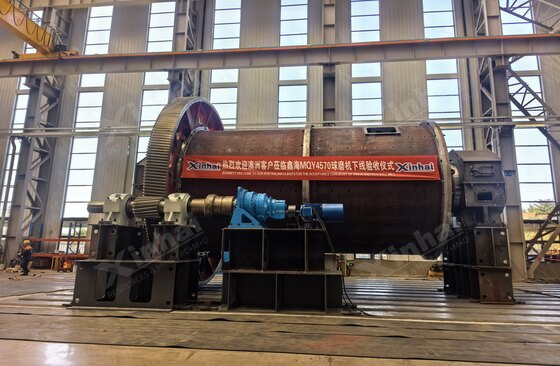
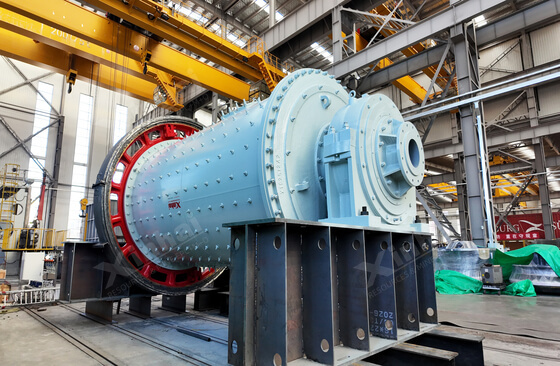
In early September 2026, Xinhai's MQY4570, a φ4.5 × 7.0 m large ball mill built for an Australian customer, finished assembly and moved into its scheduled test run and customer acceptance at the company's manufacturing base in Yantai. On a production schedule that is one line. On the shop floor it is the end of a chain that most mining equipment suppliers never attempt: rolling and welding a shell this size, machining a flange up to 8,000 mm, cutting and heat treating a girth gear, proving the welds with non-destructive testing, and then moving a piece that will not fit inside a container to a port and onto a vessel.
The reason any of this matters to a mine owner is arithmetic. Grinding takes roughly 30% of a concentrator's operating cost, and the ball mill accounts for about half of that. A large ball mill that is late, out of round, or badly geared does not just cost money to fix. It delays commissioning and locks up capital.
Why Large Ball Mills Are Hard to Build and Ship
The industry treats φ4 m and above as the large-mill class. Industry figures Xinhai tracks put the global mining ball mill market at about USD 4.25 billion in 2025, heading to roughly USD 5.65 billion by 2032 at a little over 4% compound growth, with China accounting for more than a third of global sales and growing faster than the average. Demand is moving in one direction: bigger, more efficient, more instrumented. By the end of 2025, close to 90% of domestic concentrators were running ball mills of 3.2 × 4.5 m or larger, and sales of units above 3,000 kW roughly doubled between 2024 and 2025.
That scale concentration has split the supply base. The small and mid-size segment holds more than 320 domestic manufacturers and competes mostly on price, with margins around 12% to 15%. The large intelligent segment, where mills are engineered rather than quoted, is where margins run closer to 28% to 35%.
For a large ball mill, the barrier is not assembly. It is the heavy thermal and machining steps that come first:
- Shell rolling and welding. Plate up to 50 mm thick and 3,200 mm wide has to be rolled to radius and welded with full penetration, then stress relieved. Distortion here shows up later as runout and bearing wear.
- Flange and end-cover machining. A mill in this class needs flange faces machined to 8,000 mm. End covers for a 3.6 m drum need a vertical lathe with 4 m capacity.
- Girth gear cutting. Large mill gears run to 10 m in diameter with a module up to 40 mm. Few shops own a hobbing machine that can cut one.
- Heat treatment and inspection. Welds and castings need non-destructive testing by certified personnel before anyone signs off.
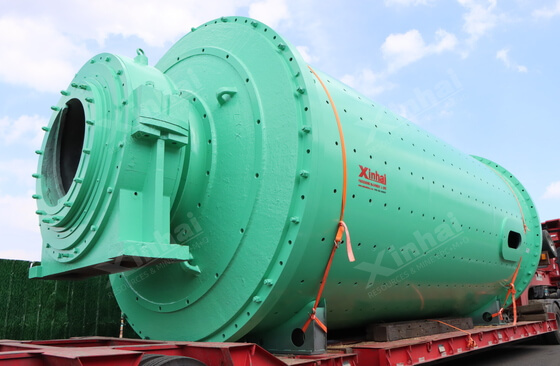
- Logistics. A large mill is break-bulk cargo. It needs a route survey, special packaging, port handling and customs clearance coordinated with the vessel, not a booking made the week before.
Xinhai's Manufacturing and Delivery Capability
1. Company Scale Behind the Machine
Xinhai was founded in 1997 and runs a full-industry-chain EPC+M+O model, covering mineral processing test work, mine design, equipment manufacturing, construction, installation, commissioning and mine operation. The numbers behind every large ball mill Xinhai ships:
- 2,500+ mines served, including 600+ EPC+M+O projects
- 1,000+ processing machines and 40+ overhead cranes at 200 t and 100 t
- More than 170 shipments and 250+ containers dispatched in the first half of 2025 alone
Being the large ball mill manufacturer and theEPC contractoron the same project changes the incentives. The mill is specified against the flowsheet it has to feed, and the same organisation carries the commissioning risk.
2. The "3 Academies, 5 Centers" Technical Matrix
R&D sits in three institutes and five centres rather than a single lab:
Three institutes
- Mine Research Institute. A 3,000 m² facility with a provincial-level mineral comprehensive utilisation pilot plant and a national-level postdoctoral research station. It runs the full chain from exploratory bench tests through laboratory and semi-industrial pilot campaigns, across more than 70 mineral types.
- Mine Design Institute. Works to Australian, Canadian and European design practice, including JORC and NI 43-101 reporting frameworks and BIM-based delivery. It has supported 2,500+ mines and 600+ EPC projects.
- Intelligent Equipment Research Institute. Focused on mechanical dynamic design, engineering simulation and intelligent control for the equipment itself.
Five centres
- Pilot Center for Underground Tailings Backfilling
- Pilot Research Center for Mineral Processing
- Equipment Physical & Chemical Testing Center
- Wear-resistant Rubber R&D and Testing Center
- Automation R&D and Testing Center
The mineral processing pilot centre is the reason a mill can be sized from data.Test worksets the work index, the feed size and the target grind, and those three numbers set the mill.
3. Large Equipment Manufacturing
The heavy-duty machine shop is where a large ball mill of the 4.5 m class is actually made. Installed capability includes:
Machine
Capability
What it makes
C540 Double-column Vertical Lathe
Flange machining to 8,000 mm
Mill shells, flotation tank rings
CX6060 Floor-type Lathe
6 m diameter, 10 m length
Ball mill cylinders
Y311000K Gear Hobbing Machine
2.4 m to 10 m diameter, module to 40 mm
Girth gears for φ5.5 m ball mills
CKXD5280X4/100 CNC Vertical Lathe
Up to 4 m diameter
End covers for 3.6 m drum mills
W11S-50×3200 Plate Rolling Machine
50 mm plate, 3,200 mm width
Mill cylinders, tank bodies
QDXX 200/75-25.5 Crane
200 t lift, 28 m height
Handling ultra-large mills
A separate light-duty machine shop handles small and medium components, and an Advanced Materials R&D and Manufacturing Base produces Xinhai's own wear-resistant rubber, polyurethane and engineering plastics, which is where mill liners come from. Controlling the liner chemistry in-house matters because liner profile is a grinding-efficiency variable, not just a wear item.
4. Large Ball Mill Delivery Assurance
Getting a large ball mill out of the factory intact is its own discipline:
- ERP "one project, one code" management. Every component carries a unique project code, which is how Xinhai targets zero shipping errors.
- Certifications. ISO 9001:2015 quality, ISO 14001:2015 environmental, ISO 45001:2018 occupational health and safety, EU CE certification, ISO 9712 non-destructive testing qualification, and CSA W47.1 from the Canadian CWB.
- Packaging, shipping and customs clearance handled as one integrated logistics system, with a modular and prefabricated base that pre-assembles crushing, grinding and separation modules so site work is shorter.
- Energy-saving design. Rolling bearings in place of sliding bearings and grooved ring liners reduce energy consumption by 20% to 30%, across energy-saving grate, overflow and cone series.
- Customisation. Mill type, liners, grinding media and bearings are selected against ore hardness, feed size and target fineness rather than pulled from a catalogue.
Overseas Partial Ball Mill Projects, Largest to Smallest
The mill sizes below are drawn from Xinhai's project records, ordered by specification.
Mill specification
Project
Country
Ore
Capacity
MQYg4576 (φ4.5 × 7.6 m) overflow
Limestone EPC project
Indonesia
Limestone
2,000,000 t/a
MQY4570 (φ4.5 × 7.0 m)
Ball mill supply, customer acceptance
Australia
-
-
φ4.5 × 6.0 m
Spodumene project (Bikita)
Zimbabwe
Spodumene (lithium)
2,000,000 t/a
MQGg3645 (φ3.6 × 4.5 m) grid
Gold CIL plant
Guinea
Gold
3,000 t/d
2750 model (φ2.7 × 5.0 m)
Galena-fluorite plant, Sardinia
Italy
Galena-fluorite
1,200 t/d
2136 model (φ2.1 × 3.6 m)
Galena-fluorite plant, Sardinia
Italy
Galena-fluorite
1,200 t/d
MQYg2445 (φ2.4 × 4.5 m) wet overflow
Gold mine
Indonesia
Gold
-
MQYg2130 (φ2.1 × 3.0 m) overflow
Gold mine (SPS)
Russia
Gold
-
MQYg1530 (φ1.5 × 3.0 m)
Mineral processing plant
Kazakhstan
Not recorded
-
The MQY4570 row is the unit this article opened with, a φ4.5 × 7.0 m mill for an Australian customer that finished assembly and entered its test run and customer acceptance in early September 2026.
The two Italian mills are worth singling out. The Xinhai Italy galena-fluorite project is a 1,200 t/d plant in Sardinia, built under EU conformity requirements, with the 2750 and 2136 units tested in December 2024. A large ball mill bound for the EU has to arrive with the documentation and guarding that conformity demands, which is a delivery problem as much as a manufacturing one.
Other overseas ball mill shipments where the exact model is not stated in available records include a 2,000 t/d copper project in Cape Town, South Africa; a 250,000 t/a copper project in Kazakhstan; a gold project in Ghana; a 360,000 t/a chromite plant in South Africa; and a site in Iran. Together with the table above, they cover a spread from 4.5 m diameter down to 1.5 m, which is the practical range most concentrators are specifying within.
What to Check Before You Order a Large Ball Mill
Five questions separate a supplier that can make a large ball mill from one that can only quote it.
1. What is the actual machining envelope? Ask for the maximum diameter, length and gear module the shop can cut. A shell at 4.5 m needs roughly 6 m of lathe capacity and a gear hobber that reaches 10 m.
2. Who signs the non-destructive testing? Look for ISO 9712 qualified personnel and retained inspection records, not a statement that testing was done.
3. Where do the liners come from? Liner profile drives grinding efficiency and wear life. An in-house rubber operation is a different proposition from a bought-in liner.
4. How does it leave the country? Break-bulk cargo needs packaging, route and customs planning. Ask who owns that.
5. Is the mill matched to the ore? A galena-fluorite ore has different grinding requirements from a hard sulphide or a limestone. The fluorite flotation circuit it feeds will dictate the target grind, and that number should come out of test work.
FAQ
What size counts as a large ball mill?
Generally φ4 m and above. In China's concentrator fleet, mills of 3.2 × 4.5 m and larger were in about 89% of operations by the end of 2025, and that share keeps rising as throughput grows and head grades fall.
What is the largest ball mill Xinhai has delivered overseas?
On available records, the MQYg4576 (φ4.5 × 7.6 m) overflow ball mill supplied to a 2,000,000 t/a limestone EPC project in Indonesia, followed by the MQY4570 (φ4.5 × 7.0 m) built for an Australian customer and the φ4.5 × 6.0 m mill on the 2,000,000 t/a spodumene project in Zimbabwe.
Does Xinhai build mills for the European market?
Yes. Two mills, a 2750 model and a 2136 model, run at Xinhai's 1,200 t/d galena-fluorite plant in Sardinia, Italy, delivered under EU conformity requirements. Xinhai holds EU CE certification alongside ISO 9001, ISO 14001 and ISO 45001.
How much energy can a modern large ball mill save?
Xinhai's energy-saving measures, including rolling bearings replacing sliding bearings and grooved ring liners, cut energy consumption by 20% to 30% compared with conventional configurations.


 zz540045886@gmail.com
 Chat
Chat



 Consult
 Message
 Email
Email